research
The Archive Teaches the Chemist What Training Missed
With model weights fixed, adding reaction precedents raised top-one retrosynthesis accuracy from 13.0 to 58.0 percent on transformations excluded from training.
Summary
With model weights fixed, adding reaction precedents raised top-one retrosynthesis accuracy from 13.0 to 58.0 percent on transformations excluded from training.
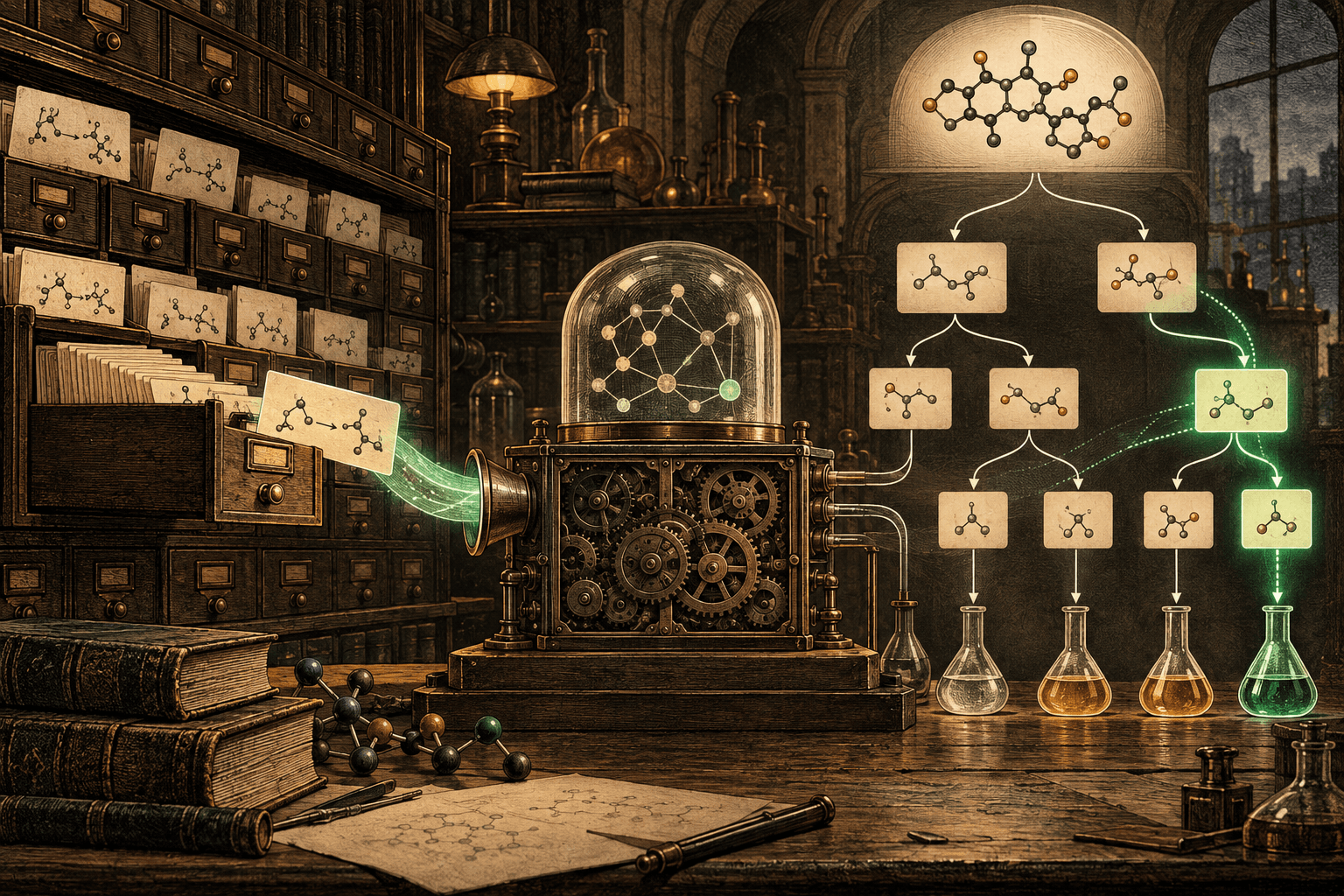
A retrosynthesis model normally inherits the chemical coverage of its training set. Researchers tested whether an inference-time archive could stretch that boundary by holding model parameters fixed while expanding only the retrievable reaction precedents. Across 2.71 million reactions, mean top-one accuracy on transformations excluded from training rose from 13.0 to 58.0 percent on a historical test and from 4.9 to 23.1 percent on a temporally held-out test. A model trained only on records before 2017 matched or exceeded a non-retrieval model trained through 2025 once newer precedents were available, and precedents improved all 14 tested general-purpose models. The work measures benchmark prediction rather than laboratory synthesis, but it isolates retrieval as a way to extend task coverage without changing weights.
Why it matters
With model weights fixed, adding reaction precedents raised top-one retrosynthesis accuracy from 13.0 to 58.0 percent on transformations excluded from training.
Limits and context
- Researchers tested whether an inference-time archive could stretch that boundary by holding model parameters fixed while expanding only the retrievable reaction precedents.
- A model trained only on records before 2017 matched or exceeded a non-retrieval model trained through 2025 once newer precedents were available, and precedents improved all 14 tested general-purpose models.
- The work measures benchmark prediction rather than laboratory synthesis, but it isolates retrieval as a way to extend task coverage without changing weights.
Key claims
With model weights fixed, adding reaction precedents raised top-one retrosynthesis accuracy from 13.0 to 58.0 percent on transformations excluded from training.
Qualification: Researchers tested whether an inference-time archive could stretch that boundary by holding model parameters fixed while expanding only the retrievable reaction precedents.
Evidence: source-2026-10-31-002
Sources
- arXiv preprint 2610.40249, original v1arXiv · primary research
Corrections
No corrections have been recorded for this story.