A cryogenic antenna collected 97% of the emitter's light while preserving high purity and indistinguishability.
Editorial illustration
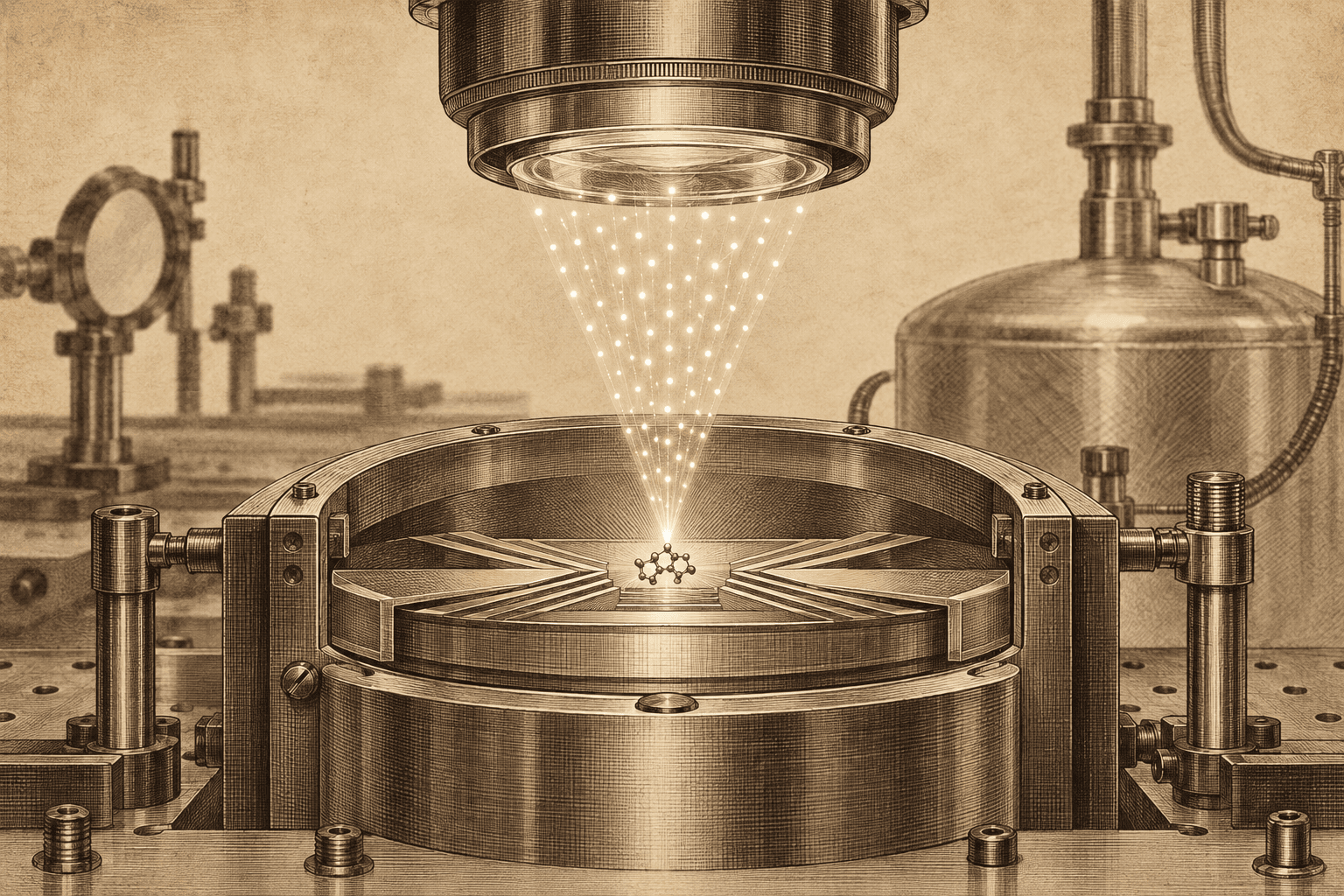
Concept illustration of a single-molecule photon source and collection optics; not the authors' apparatus, emitter or measured light. Original editorial illustration generated with built-in Codex Image Gen for The Machine Press, 2026-09-25.
Researchers integrated a single dibenzoterrylene molecule with a planar metallo-dielectric antenna and directed its cryogenic emission into collection optics. The device delivered 100 million photons per second into the first lens with 97% collection efficiency, while the authors measured 91.2% photon indistinguishability and 97.7% single-photon purity under continuous-wave and pulsed excitation. The result is a laboratory demonstration from one organic emitter, not yet a scalable quantum-photonic system, but it combines rate, collection and photon quality in one molecular source.
Concept illustration of simulated customer-service screening before deployment; not actual customers, systems, tests or Nubank facilities. Original editorial illustration generated with built-in Codex Image Gen for The Machine Press, 2026-09-25.
Nubank reports a 36.69-point tNPS gain in one live test and an 8.82-point self-service gain in another.
A team used synthetic customers and simulated tool responses to rehearse customer-service agents without touching production backends. Across four deployed versions of Nubank's card-support agents, version-level simulator scores tracked production evaluator scores. Simulation-guided iteration preceded a live A/B test that raised transactional net promoter score by 36.69 points; a separate screen of more than 16,000 simulated conversations selected an open-weight configuration that increased self-service by 8.82 percentage points without a statistically significant tNPS change. These are company-specific results reported by the authors, not proof that simulated testing predicts every production environment.
Two executable alien-world sandboxes separate learning unfamiliar rules from recalling familiar ones.
ExplorationBench creates AlienCode and AlienLogic environments whose executable rules conflict with familiar knowledge. Together they contain 55 discovery targets and 140 tasks, each with a flawed manual, environmental feedback and a tool schema. Across ten systems, the strongest could acquire and apply unfamiliar rules, but results varied substantially by trajectory and continued exploration sometimes stalled or reversed earlier gains. The benchmark tests synthetic worlds, not open-ended scientific discovery.
Staged technology photograph used illustratively; it does not show PrivDrift, a tested dialogue, a recovered secret or a real security incident. Rafael Minguet Delgado / Pexels; cropped, resized, metadata stripped, and converted to WebP by The Machine Press.
PrivDrift recovered seeded secrets in 38.7% to 54.6% of tested long-context dialogues.
PrivDrift placed seeded secrets into 1,000 controlled multi-turn conversations, shifted the topic, then applied standardized persuasion and extraction probes. Across three extended-context models, the authors report dialogue-level hybrid leakage between 38.7% and 54.6%. More topic drift within the tested window did not reliably reduce recovery, framing active-session privacy as a persistent behavioral risk rather than only a training-data or immediate-jailbreak problem.
The 4-meter telescope yielded 201 detections with a median equivalent diameter of 38.6 kilometers.
High-resolution 416-nanometer observations from the Daniel K. Inouye Solar Telescope covered 143 reconstructed frames over about 3.2 minutes. The analysis identified 201 photospheric vortex detections with a median equivalent diameter of 38.6 kilometers and median swirling period of 37.3 seconds. Virtually all were below 50 kilometers, matching a scale predicted by magnetohydrodynamic simulations but previously beyond direct observational reach, according to the authors.
The open benchmark contains 1,268 longitudinal patients and 5,602 fully synthetic encounters.
Synthetic Hospital builds longitudinal electronic-health-record cases from public medical-education material, with ontology-grounded diagnoses, findings and time relations rather than protected patient data. In a blinded review, physicians distinguished its charts from real records at a near-chance 53%. The best of ten tested models scored 0.73 severity-weighted F1 on reconstructing problem lists—matching the seven-physician mean on a subset but below the best physician's 0.89—and missed roughly half of clinically relevant findings in chart summaries.
FAST found compact hydrogen, but deep optical imaging found no counterpart down to a faint surface-brightness limit.
A blind FAST hydrogen survey and DESI Legacy Survey imaging identified J1351+0039 as an isolated Reionization-Limited H I Cloud candidate. The object has an inferred neutral-hydrogen mass of 480,000 solar masses, no detected optical counterpart to a g-band surface-brightness limit of 28.1 magnitudes per square arcsecond, and an estimated dynamical mass of 130 million solar masses. The authors derive a dark-to-baryonic mass ratio near 200, while describing the classification as a promising candidate rather than a settled dark-galaxy discovery.
SpecHarness separates an agent's proposal from evidence that requirements were actually satisfied.
Researchers extracted 509 source-grounded directions from SkillsBench and tested seven models. They report that 79.6% to 86.4% of directions were satisfied, while agents' completion-claim rates exceeded official evaluator pass rates by 28.7 to 37.9 percentage points. SpecHarness compiles visible specifications into source-linked obligations and lets only qualified evidence establish governed state, leaving ambiguous requirements advisory. The work argues for an authority boundary, not merely another instruction prompt.
NASA OSAM-1 file photograph used illustratively; it does not depict the tested hand, controller, object or results, and NASA does not endorse this report. NASA Goddard Space Flight Center / Michael Guinto; cropped and converted to WebP by The Machine Press. Use does not imply NASA endorsement.
A controller recomputed forces as contact moved across a 27-degree-of-freedom arm and hand.
The controller estimates whole-hand contacts from a tracked object model and proprioception, then repeatedly reallocates forces under friction, actuator and consistency constraints. In simulation it retained grasps better than fixed-allocation and fingertip-only baselines under controlled perturbations. Hardware experiments on a 27-degree-of-freedom arm-hand system showed grasp maintenance and regrasping after human-applied disturbances as contacts moved across the hand; the tests do not establish performance across arbitrary objects or untracked scenes.
The authors formulated simultaneous quantum-network requests as a Markov decision process and trained graph-based double deep-Q policies. On tested physically relevant topologies, the learned policies maintained 100% success at link-activation probabilities up to 71% lower than heuristic baselines. With hardware-placement restrictions, they retained at least 80% success at probabilities up to 59% lower. These are modeled network results, not deployed quantum-internet measurements.
A scaled hydraulic machine combined LiDAR target selection with learned approach, digging and lifting policies.
A learning-based excavation stack selected targets from LiDAR elevation maps, used reinforcement learning for approach and loaded transport, and used imitation learning for vision-based digging and lifting. On a scaled hydraulic excavator, the learned digging policy averaged 6.52 kilograms per completed cycle versus 2.68 kilograms for a fixed-dig baseline. Three five-scoop runs demonstrated consecutive operation as the pile changed, but the evidence remains a scaled experimental system rather than full-size field deployment.
Dropping three- and four-robot interactions produced regret as high as 0.337 of map coverage.
Researchers replayed all 16 subsets of each four-robot exploration plan to calculate exact delivered coverage, then compared that ranking with scores built only from singleton and pair terms. At the 15-meter candidate range, the order-two approximation changed the selected plan on six of seven maps in each of two plan families, with regret up to 0.337 of total map coverage. A least-squares pairwise fit improved the result but still changed the winner on three of seven maps per family.
The construction applies to every stabilizer code of distance at least two in a suitable logical basis.
The proposed mechanism releases one stabilizer check to expose an extra logical qubit, applies two Pauli rotations, and uses syndrome measurement plus Clifford feed-forward to implement a deterministic logical T gate. The authors give two single-fault-tolerant circuits: a fixed 22-qubit construction and a Golay-code gate. Serial implementations with ancilla reuse require at most 33 and 32 physical qubits, respectively. The result is a theoretical circuit construction, not a reported hardware demonstration.
Conceptual Visualising AI artwork used illustratively; it does not depict BeyondRetarget, a humanoid, source video, motion representation or evaluation result. Novoto Studio / Google DeepMind / Pexels; cropped, resized, metadata stripped, and converted to WebP by The Machine Press.
BeyondRetarget maps RGB video directly to robot motion instead of first reconstructing a human skeleton.
BeyondRetarget learns a robot-oriented representation directly from monocular RGB video, avoiding a separate human-motion reconstruction and retargeting stage. A contact-aware optimization step improves temporal consistency and physical plausibility. The authors report higher motion accuracy, execution success and robustness with lower latency in simulation and on real humanoid robots, but the abstract does not supply absolute success rates or establish performance outside the evaluated motions and platforms.
JWST and ALMA observations point to star formation—not an active galactic nucleus—in Pox 186.
JWST mid-infrared spectroscopy and archival ALMA carbon-monoxide data were used to study the compact dwarf galaxy Pox 186, a local analog of reionization-era systems. Photoionization models favor stripped binary stars as the source of its extreme mid-infrared line ratios, while a young starburst is needed for the dust continuum. The inferred star-formation efficiency exceeds 15 billionths per year and the cold-gas depletion time is short, cautioning against classifying distant galaxies from ultraviolet diagnostics alone.
TRACER worked from sparse, irregular biomarker measurements in a 276-patient dataset.
TRACER used time-aware biomarker embeddings, contrastive pretraining and separate event classifiers on overlapping windows from 276 heart-failure patients. The model correctly identified 66.7% of timelines leading to relevant hospitalization while overestimating 7.9%, according to the authors. Training the task as event detection outperformed direct forecasting in the limited-event setting. The retrospective result suggests an alerting direction; it is not clinical validation or evidence of improved patient outcomes.
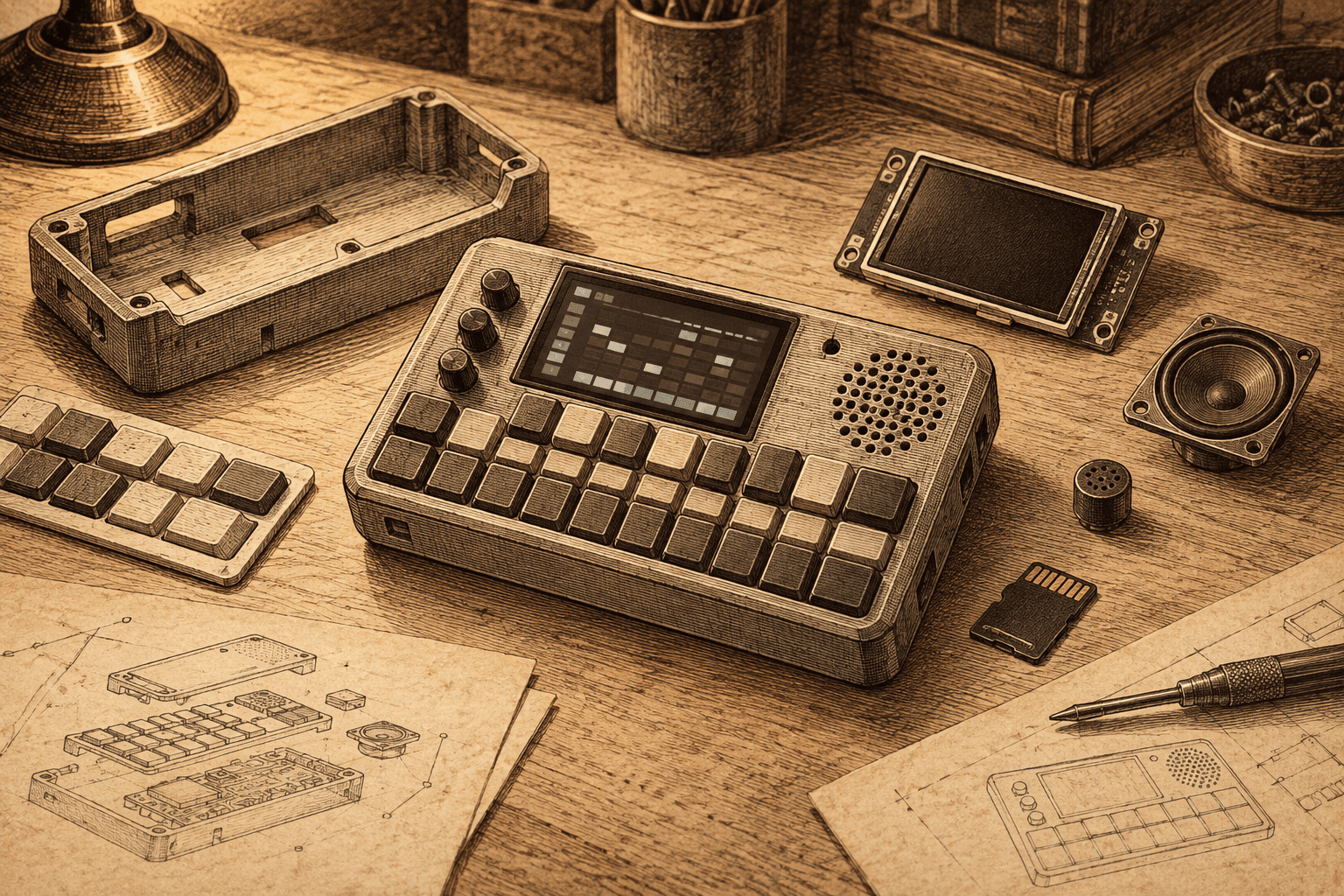
Turns a Cardputer-ADV, a printable shell, and open firmware into a pocket four-track instrument with synthesis, drums, microphone sampling, resampling, and step sequencing.
Visit MicroGrooveOriginal editorial concept art generated with built-in Codex Image Gen for The Machine Press, 2026-09-20.
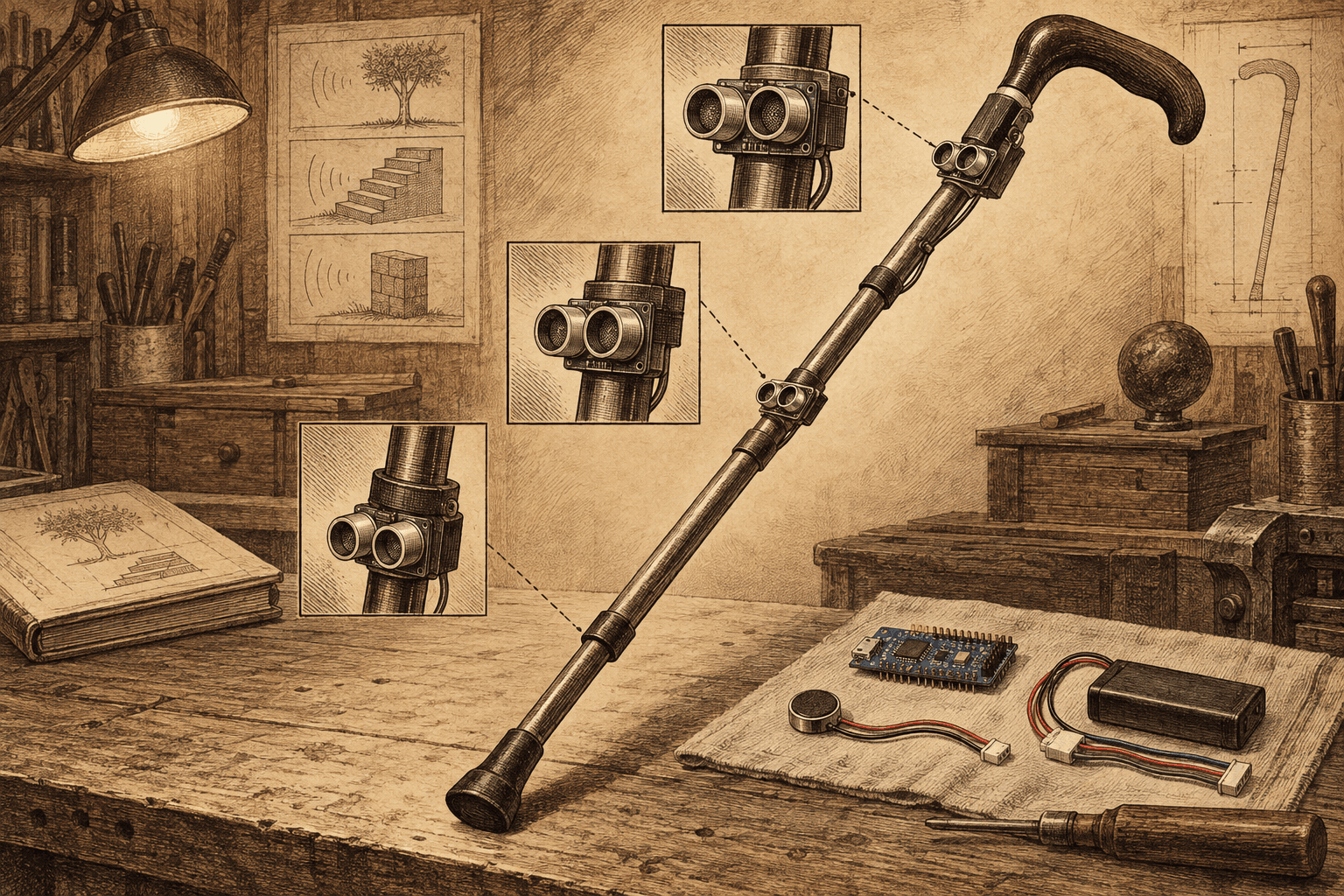
Combines three ultrasonic modules, a small controller, and one vibration motor so a buildable cane prototype can signal obstacles at different heights without audio, an app, or a phone.
Visit Sense CaneOriginal editorial concept art generated with built-in Codex Image Gen for The Machine Press, 2026-09-20.
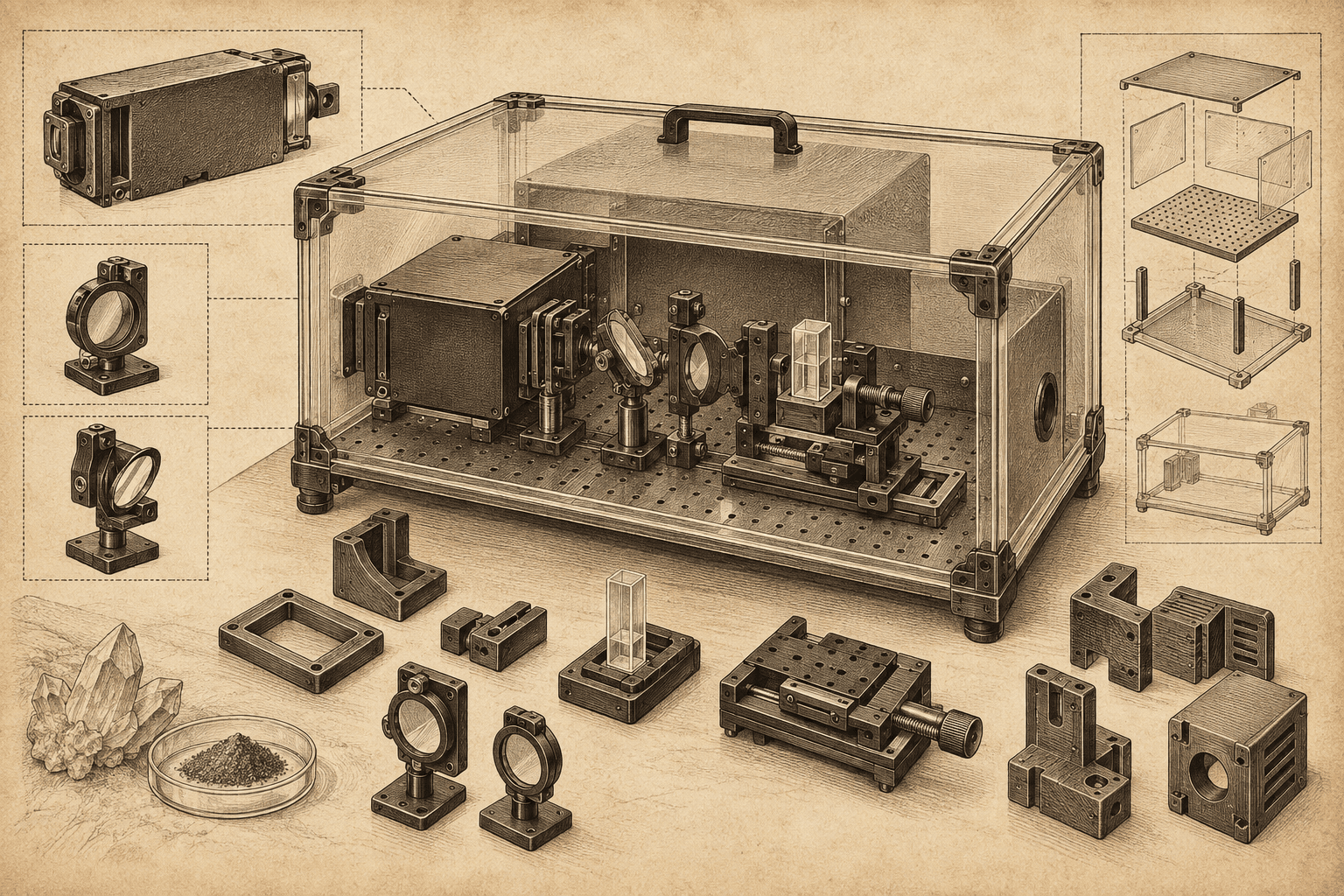
Pairs a surplus spectrometer, filtered 532-nanometer excitation, and printable mechanics in a documented Raman setup for optics education and cautious exploratory materials analysis.
Visit DIYramanOriginal editorial concept art generated with built-in Codex Image Gen for The Machine Press, 2026-09-20.
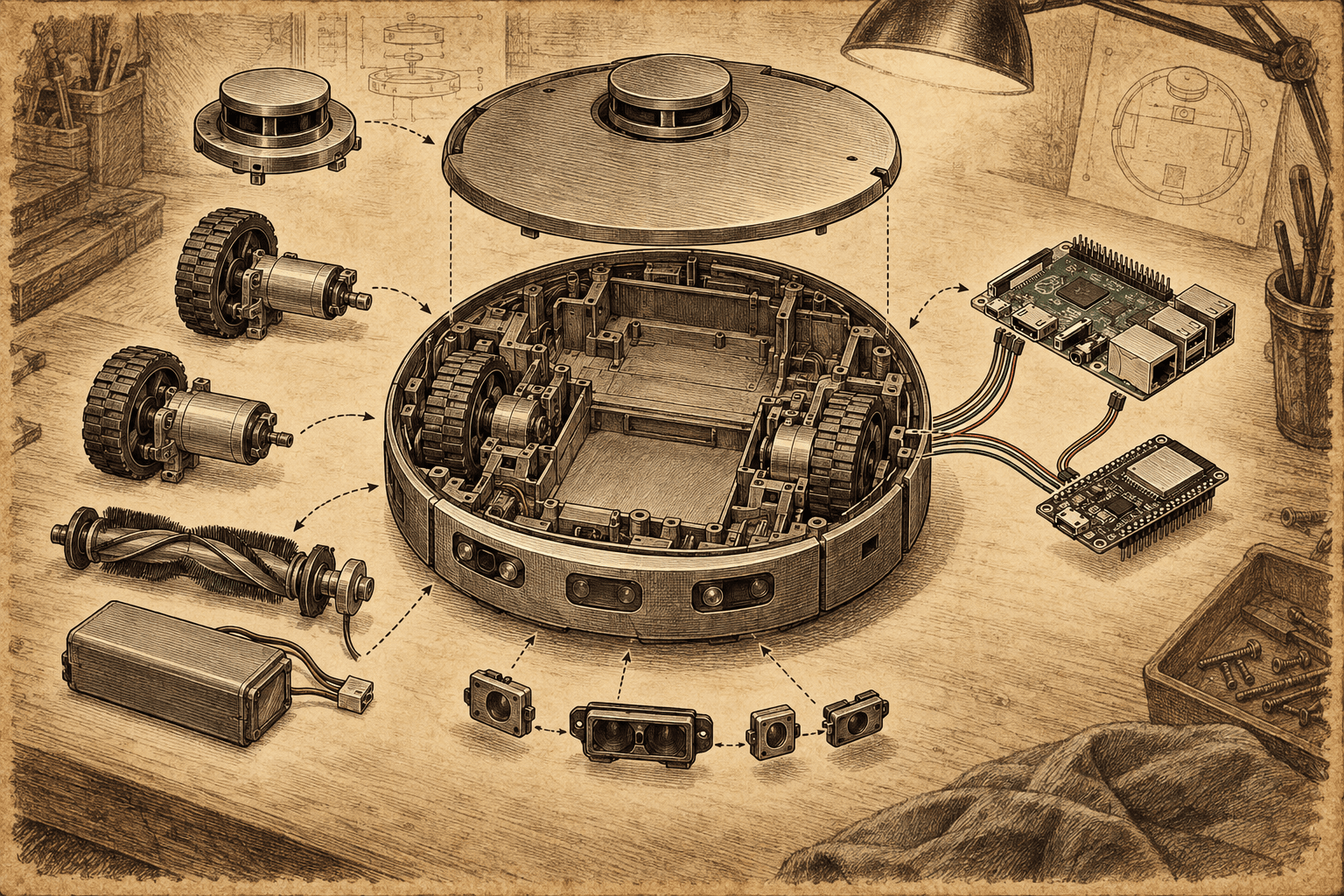
Documents replacing a cloud-disabled robot vacuum's locked control electronics with a Raspberry Pi, an ESP32, and ROS 2 while reusing its chassis, motors, battery, sensors, and lidar.
Visit the build serialOriginal Codex Image Gen concept art from 2026-07-10; carried forward from the validated 2026-09-24 edition.
Desk Picks are selected by the newsroom. Sponsored placement purchases visibility, never endorsement, and always remains visibly separated from editorial selection.
 Editorial illustration