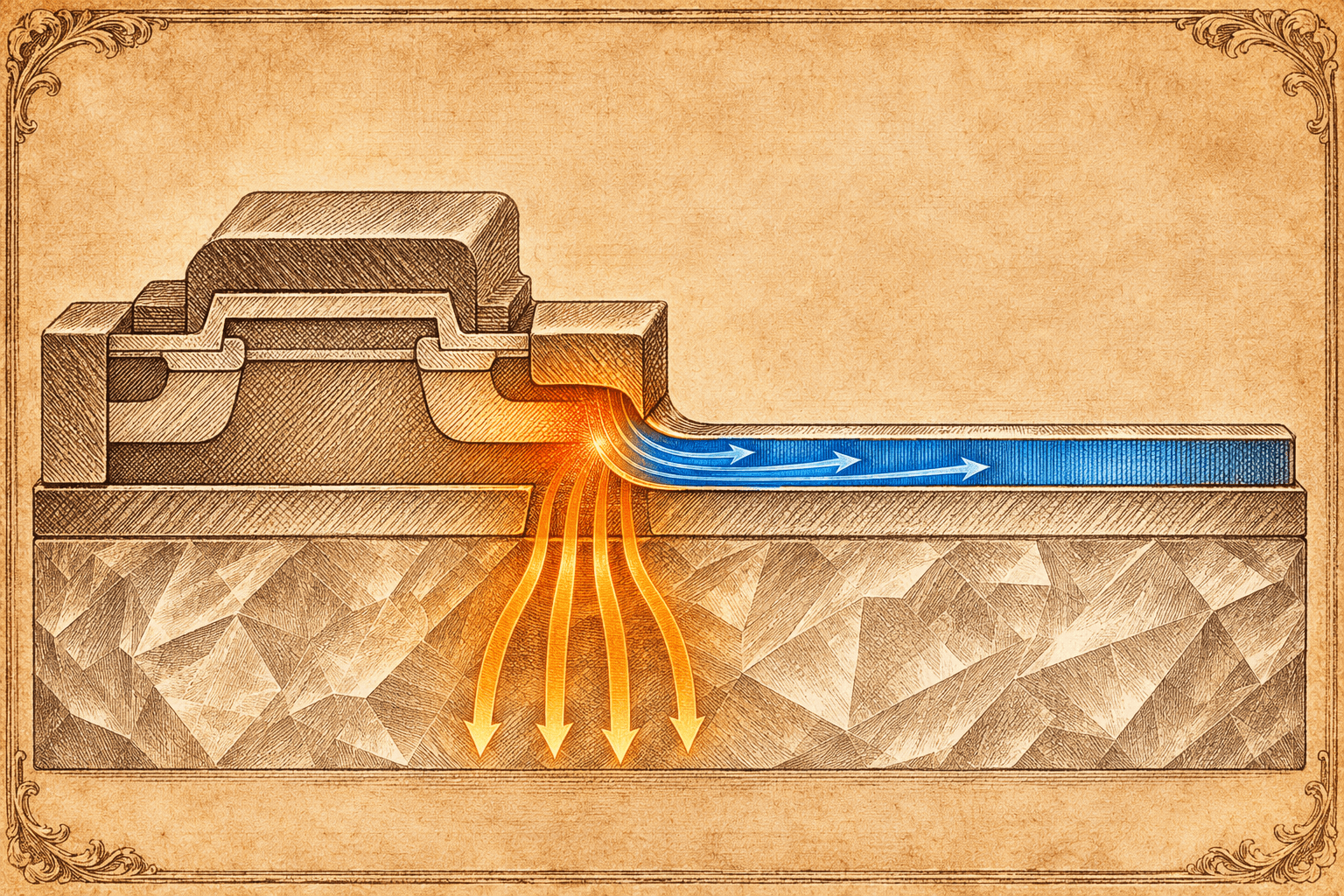
A horizontal thermoelectric film separates interface cooling from bulk Joule heat, raising the modeled cooling ceiling from 13 to 500 milliwatts.
Editorial illustration
Editorial concept illustration of the proposed horizontal near-junction cooling geometry; it does not depict a fabricated device or measured deployment. Generated with built-in Codex Image Gen for The Machine Press.
Power-transistor hotspots can exceed five kilowatts per square centimeter, while a conventional vertical thermoelectric pillar sends about half of its own Joule heat back toward the cold end. This analysis places a thin thermoelectric film horizontally beside the drain of a gallium-nitride power transistor on diamond. Peltier absorption remains localized near the interface, but volume-generated Joule heat leaves vertically through the substrate. A closed-form fin model reduces the recirculation factor from one to about 0.03 for the stated geometry. At equal electrical resistance, the model raises maximum net cooling from 13 to 500 milliwatts and the critical runaway current from 0.65 to 24 amperes. The paper supplies a design analysis and stability window for microsecond pulse cooling, not a fabricated device demonstration.
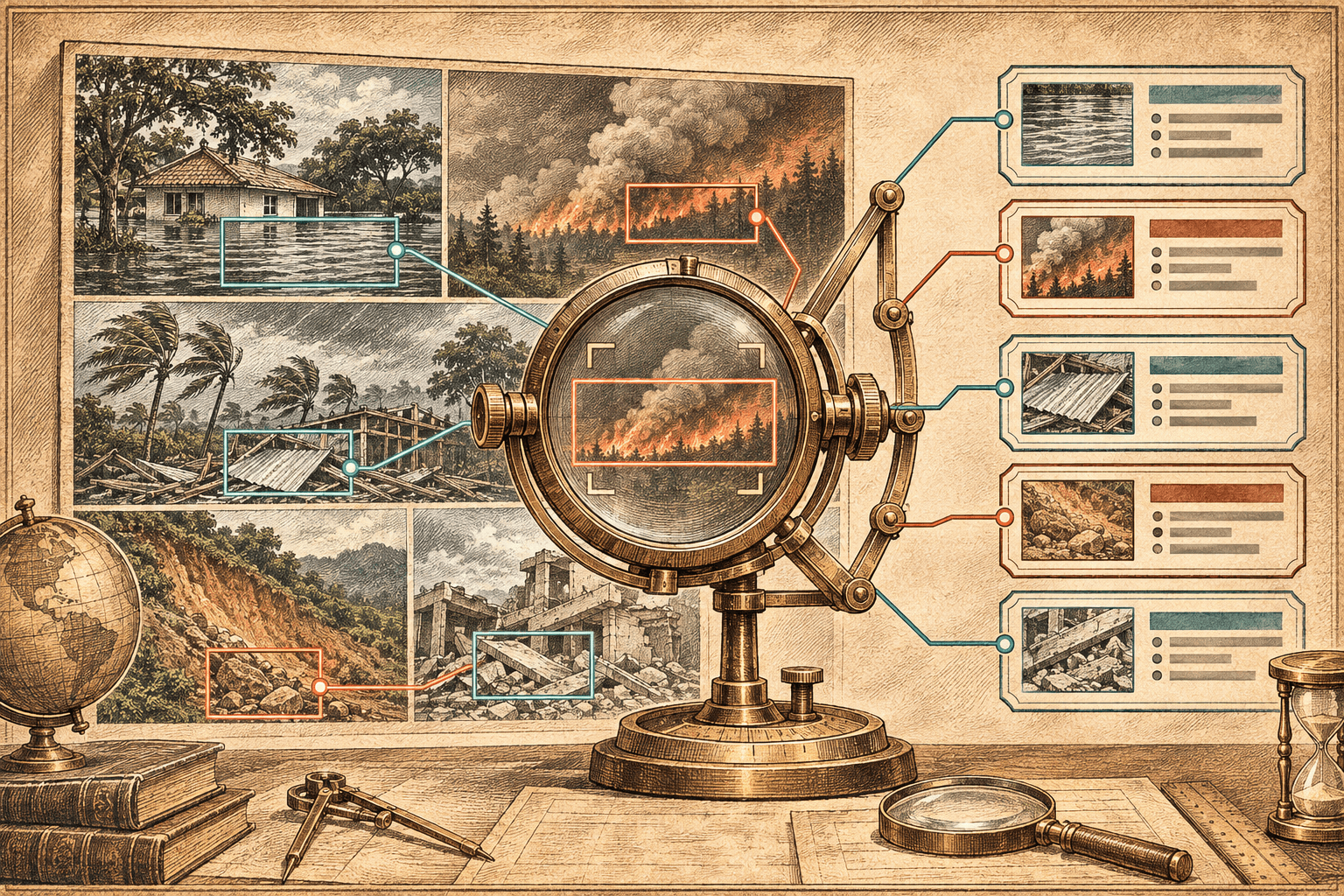
Editorial concept illustration of evidence-grounded disaster-scene reasoning; none of the depicted scenes is claimed to belong to DisasterVL. Generated with built-in Codex Image Gen for The Machine Press.
A 1.2-million-image benchmark links answers, captions and spatial relationships to visible regions across 142 countries.
DisasterVL is designed to test whether a visual model can justify what it says about a disaster scene rather than merely name a likely hazard. Its approximately 1.2 million images from 142 countries carry 25 million structured annotations spanning captions, incident and location assessments, spatial relations and visual questions. Answers are linked to visible evidence, including absent cues, while caption phrases and relationships point to image regions. The held-out set contains 38,254 images from 75 countries and 28 hazard types; Gemini 3.1 Pro audited its annotations and people validated a stratified subset. The authors report that their 9-billion-parameter DisasterVLM beats evaluated general-purpose baselines across captioning, open-ended questions, incident reasoning and region grounding, but text-overlap gains exceed evidence-score gains. The dataset, models and code are planned for release, so the current result remains a preprint benchmark claim awaiting broader independent use.
Open Sentinel-1 voltage data revealed 76 nearby objects and recovered two debris transits without orbital predictions.
Radar echo power falls with the fourth power of distance, making a nearby object dramatically brighter to a spaceborne sensor than to a distant ground radar. Using Sentinel-1 recordings from six days, catalogue-assisted processing produced a manually checked set of 76 satellites, rocket bodies and debris fragments at ranges from 41.7 to 492.9 kilometers. A blind search recovered two selected debris transits, and one short encounter improved a catalogue orbit using range and Doppler. Ground scatter remains the dominant limit for Earth-looking observations. Idealized calculations suggest millimeter-scale sensitivity at ten kilometers, but those figures assume receiver-noise conditions and coherent integration; the demonstrated sample establishes feasibility, not a complete debris census.
Illustrative data-center file image; it does not show ShadowBench-MCP, its tested router or any evaluated workflow. Brett Sayles / Pexels; cropped, resized, metadata stripped, and converted to WebP by The Machine Press.
Small task-preserving changes made one tool router skip safety steps until policy-aware routing cut the effect by 85.7 percent.
ShadowBench-MCP treats an agent's execution path as a security output. In 96 paired comparisons across six sensitive workflows, efficiency-first routing sent 29.2 percent of variants through riskier shadow routes and skipped safety tools 26.7 percent of the time. Policy-aware routing reduced those rates to 4.2 and 1.7 percent, while pre-execution signals separated shadow routes with ROC AUC up to 0.94. The evidence covers one hosted router and 120 decisions, so it identifies a policy-dependent routing weakness rather than a universal agent vulnerability.
A necessity-and-sufficiency method cut controlled multi-agent violations from 93 percent to 6 percent with fewer deletions.
Collective Dependence Analysis tests which individually harmless messages were necessary and sufficient for a group of language-model agents to produce a policy violation. Across constructed cases, unscripted conversations and recorded interactions, selected removals reduced violations from 93 percent to 6 percent in controlled settings. The method used a linear number of model evaluations and matched that reduction with half as many deletions as a frontier-model transcript judge in eligible cases. Unfamiliar tasks still produce incomplete explanations, and removing a message can disrupt correct behavior.
A formal result shows why physiology and care process cannot generally be separated from one electronic-health-record dataset.
Electronic health records mix a patient's condition with the clinical process that determines what gets measured. This paper proves that a single dataset cannot generally divide the information carried by laboratory values and ordering decisions when untested values are undefined. Cross-site outcome invariance is a falsifiable implication under added assumptions, but observationally equivalent models can disagree about the underlying biology. A worked example produces a 9.6-percentage-point site gap with the biological mechanism unchanged. Identification can return with universal testing or specially structured repeated measurements; absent that, cross-site results test a joint hypothesis, not physiology alone.
A training-free quantum-classical encoding produced identical runs and processed whole-transcriptome atlases on one server.
KQE-2 maps cells to entanglement-free quantum states whose features can be evaluated exactly on classical hardware and checked on a quantum processor. The authors report that retraining scVI moved 14 percent of cells, while KQE-2 returned identical biological groupings across runs. Its encoding raised accuracy on a developing-cortex dataset from 0.61 to 0.79 and scaled to 11.4 million nuclei on one server, leading eight of ten complete atlases and staying within the best method's run-to-run range on the other two. These are preprint benchmark results, not evidence of quantum hardware speedup.
Photon-number correlations narrowed temporal features 11.8-fold and spatial features 5.1-fold in a proof-of-principle experiment.
The experiment splits classical thermal light in a Hanbury Brown-Twiss interferometer and resolves photon counts in both arms. Correlating multiphoton subsystems produces a peak or dip whose width can be tuned with average photon number. The authors report 11.8-fold temporal and 5.1-fold spatial resolution enhancements; a double pinhole unresolved by ordinary ghost imaging becomes distinguishable in a two-photon-versus-zero-photon correlation. The six-page preprint presents a proof of principle, not a general-purpose imaging system.
Illustrative fiber-optic macro photograph; it does not show UltraGuard, ultrasound, a phone or an embedded watermark. Atlantic Ambience / Pexels; cropped, resized, metadata stripped, and converted to WebP by The Machine Press.
UltraGuard fuses ultrasonic measurements with video dynamics to watermark face video during capture and transmission.
UltraGuard uses a phone's speaker and microphone to emit and receive ultrasonic signals, then combines the resulting biometric features with spatiotemporal information from the video. The fused signal becomes a changing, content-aware watermark embedded in real time rather than an offline mark added afterward. The authors report resistance to forgery and editing at capture and during propagation. Their paper describes experimental validation and a future mobile deployment path; it does not establish field performance across phones, environments or every deepfake pipeline.
A single policy maps short noisy measurement windows to actions without plant matrices or an explicit state estimator.
Classical optimal control normally builds a controller for one plant. Here one transformer imitates linear-quadratic-Gaussian control across linear systems with different dimensions, costs and noise. Standardization, padding, masks and encoded covariance data let the same weights act on every member of the family. Across 28 simulated systems, median cost landed within 0.4 percent of optimum on seen systems; light fine-tuning brought unseen systems to a 1.0 percent median gap. The result is simulation on linear plants, not a guarantee for nonlinear hardware.
Adaptive agentic red teams found tool-output attacks against models that appeared robust on public static benchmarks.
The study builds a synthetic evaluation in which random benign actions become adversarial goals, separating instruction-hierarchy failures from knowledge of familiar security scenarios. More capable attacker agents iteratively adapt injections placed in tool output. The authors report that these attackers reliably induced models to follow injected instructions even when the models had looked robust on GraySwan Arena. Exact cross-model rates are not stated in the abstract, and the work is an adversarial evaluation rather than evidence of exploitation in deployed systems, but it argues that static human red-team payloads can understate current risk.
EntNet selects compact local observables and transfers its witness across spin-chain sizes and Hamiltonian families.
EntNet learns combinations of experimentally measurable Pauli correlators that distinguish entangled mixed states from fully separable ones. From local-unitary-invariant features up to four-body order, the system sparsely selects sixteen channels and models their spatial organization with a transformer. The authors report more than 98 percent recall on certified entangled states with near-zero false positives on separable states, plus transfer across system sizes, frustrated models and disordered Hamiltonians. Its learned finite-temperature boundary follows the excitation gap in the analyzed setting; physical deployment still depends on measurement quality and the tested model families.
A coding agent assembled simulation-learned handovers, topples, pushes and recovery into graph-based control for physical robots.
Flipping an object 180 degrees on a support surface requires different strategies for thick, thin, stable and awkward shapes. A coding agent iteratively developed those strategies in physics simulation, progressing from handover to toppling, pushing, robust grasping, sensing and recovery. Reported simulated success rose from 24.7 to 95.0 percent. The resulting graph-based code combines high-level strategy selection with reactive control and executed multi-stage flips on physical bimanual robots. The abstract does not claim universal object coverage; the result is tied to the studied geometries and setup.
Operational workload and admission flow added independent signals to a multimodal readmission-risk model trained on 20,000 ICU stays.
ICU discharge decisions reflect both patient state and hospital capacity, but many models represent only the patient. This system combines cleaned progress notes, departmental workload, admission flow, vital signs and diagnosis codes. Across twenty runs on 20,000 MIMIC-III stays with roughly 10.5 percent readmissions, its end-to-end transformer reached AUROC 0.8288, PR-AUC 0.4373 and F1 0.4757. Raw text embeddings hurt tree models, while tuned multimodal training reversed that transfer. This is retrospective benchmark evidence from one public dataset, not a prospective clinical validation or a deployment recommendation.
Illustrative developer-workstation file image; it does not show WebTrap Farm, an evaluated harness, attack or agent session. Dhirendra Singh Dhami / Pexels; cropped, resized, metadata stripped, and converted to WebP by The Machine Press.
Paired usability tests separate genuine web-agent defenses from agents that merely fail to complete the task.
WebTrap Farm evaluates malicious user prompts, prompt injection and deceptive page design across the four stages of a web-agent harness: goal interpretation, perception, planning and execution. Paired usability tasks distinguish a safe refusal from inability to act. The authors report unsafe behavior even without explicit attack content and find statistically significant effects from both the harness and the backend model. Their analysis localizes where defenses emerge in the workflow. The abstract does not provide universal rates or name a production incident, but it shows why model-only comparisons miss deployed-system risk.
A dual-species neutral-atom architecture uses interspecies interactions to avoid locally addressed gates while compiling fault tolerance.
The proposed GRAIL instruction set uses two atom species and interspecies Rydberg interactions to select qubits under global driving. The authors compile surface-code correction and magic-state cultivation into that native language, then parallelize schedules to suppress crosstalk. Under a hardware-inferred circuit noise model, crosstalk falls to the 10^-4 level, the memory threshold reaches 1.43 percent and cultivated magic states reach modeled logical error below 10^-9 at an experimentally accessible drive frequency. These are architecture and simulation results, not a completed fault-tolerant computer.
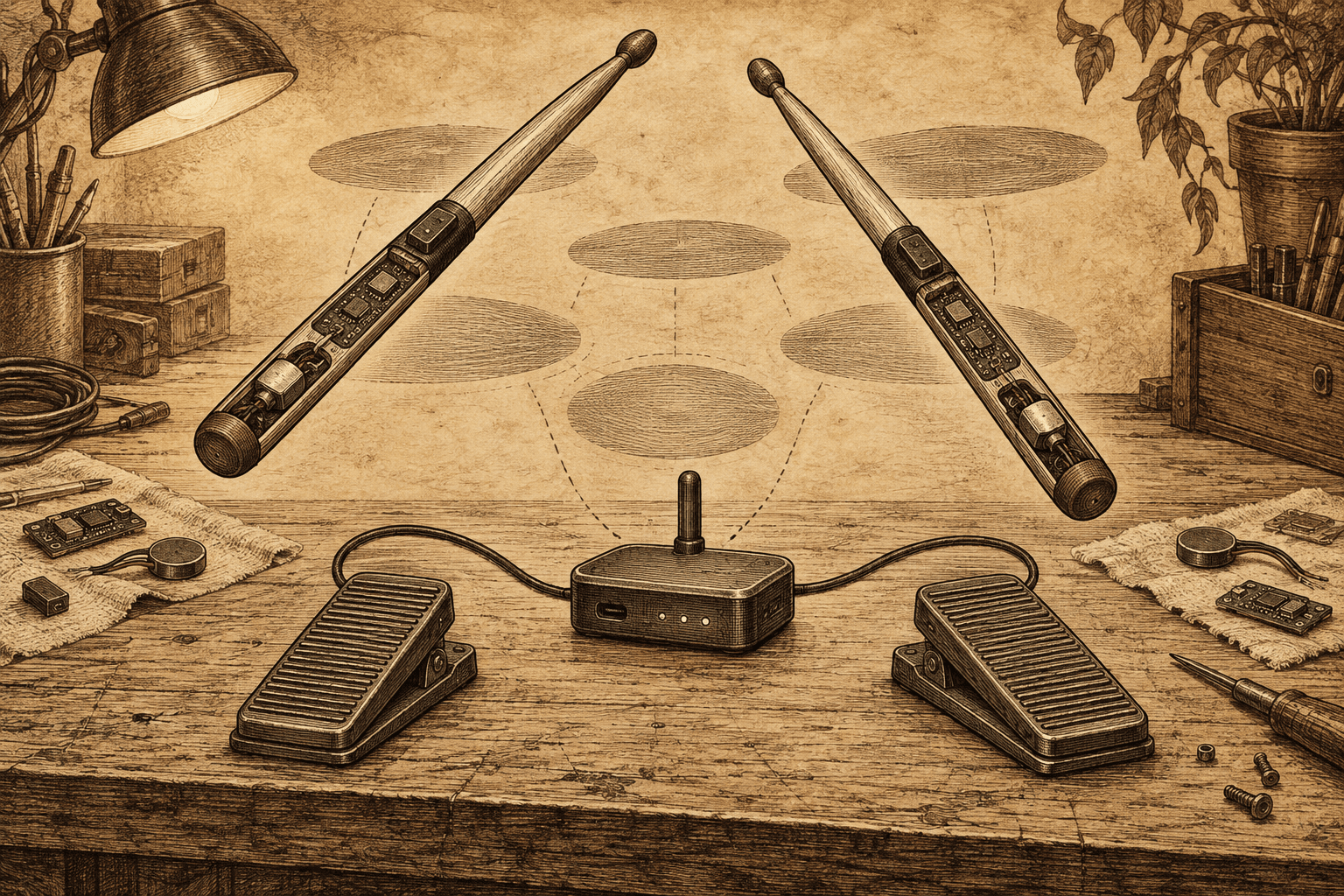
Moves motion tracking onto two ESP32-S3 drumsticks, adds haptic hits and a two-pedal hub, and sends velocity-sensitive drum events to open PC or Android playback software.
Visit Space Drums 2.0Original editorial concept art generated with built-in Codex Image Gen for The Machine Press, 2026-09-27.
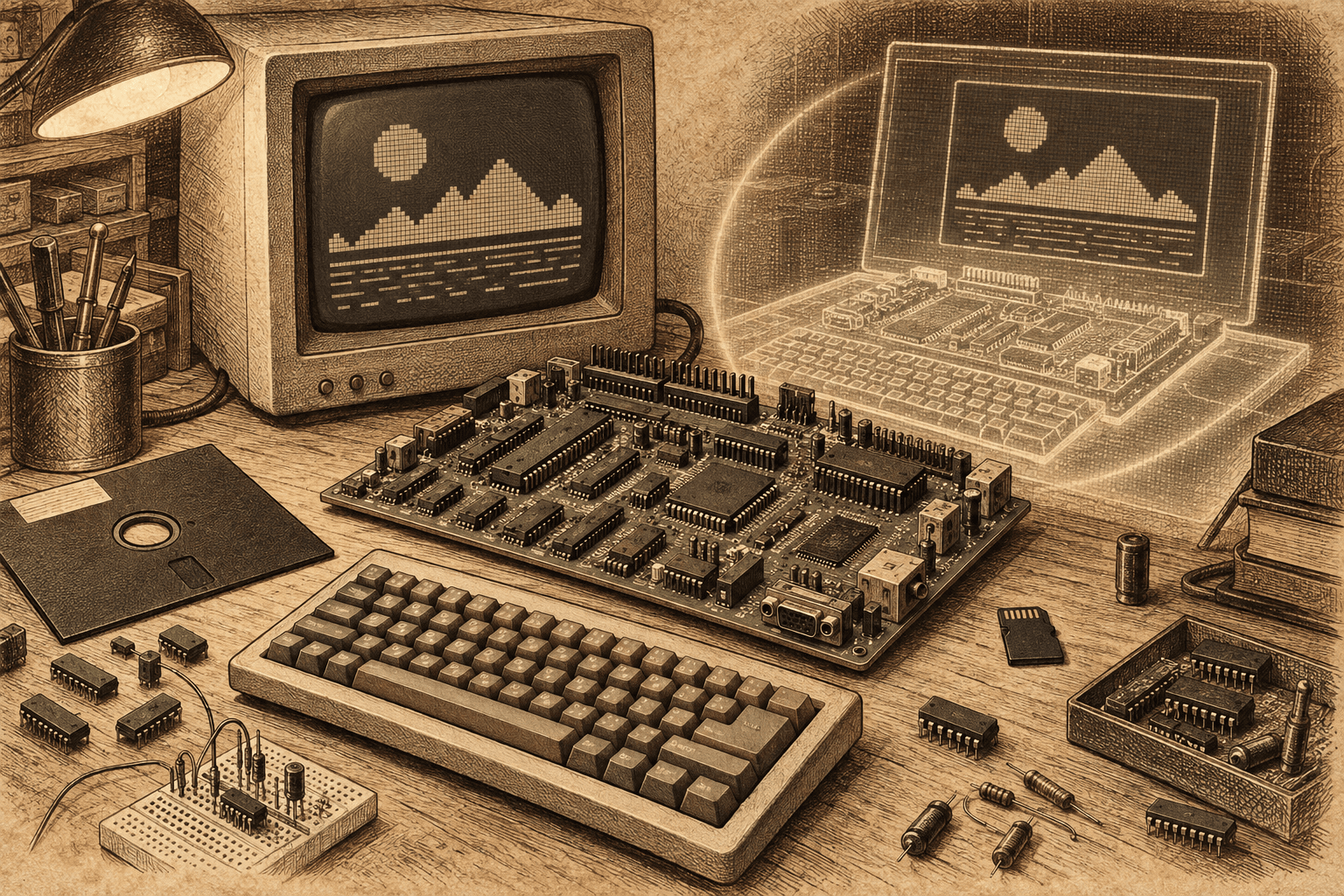
Pairs a chip-level 65C02 computer with custom hardware, video, sound, floppy, and microSD support with a cycle-honest emulator and browser assembler built around the same machine.
Visit 3RICOriginal editorial concept art generated with built-in Codex Image Gen for The Machine Press, 2026-09-27.
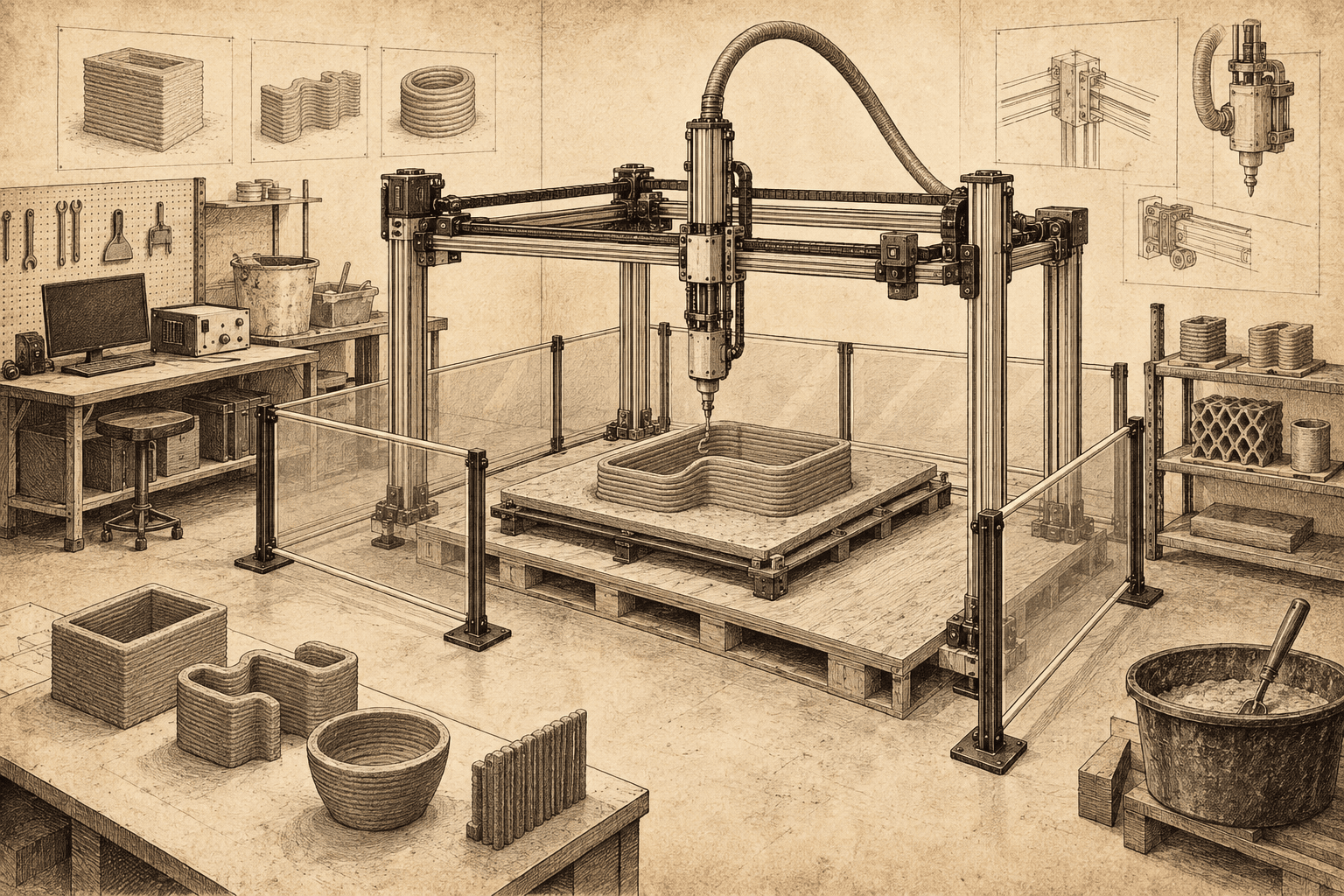
Publishes a pallet-scale cartesian motion reference, CAD, BOM, and low-voltage controls for supervised cementitious-extrusion research while explicitly excluding certified structural use.
Visit M3-CRETEOriginal editorial concept art generated with built-in Codex Image Gen for The Machine Press, 2026-09-27.
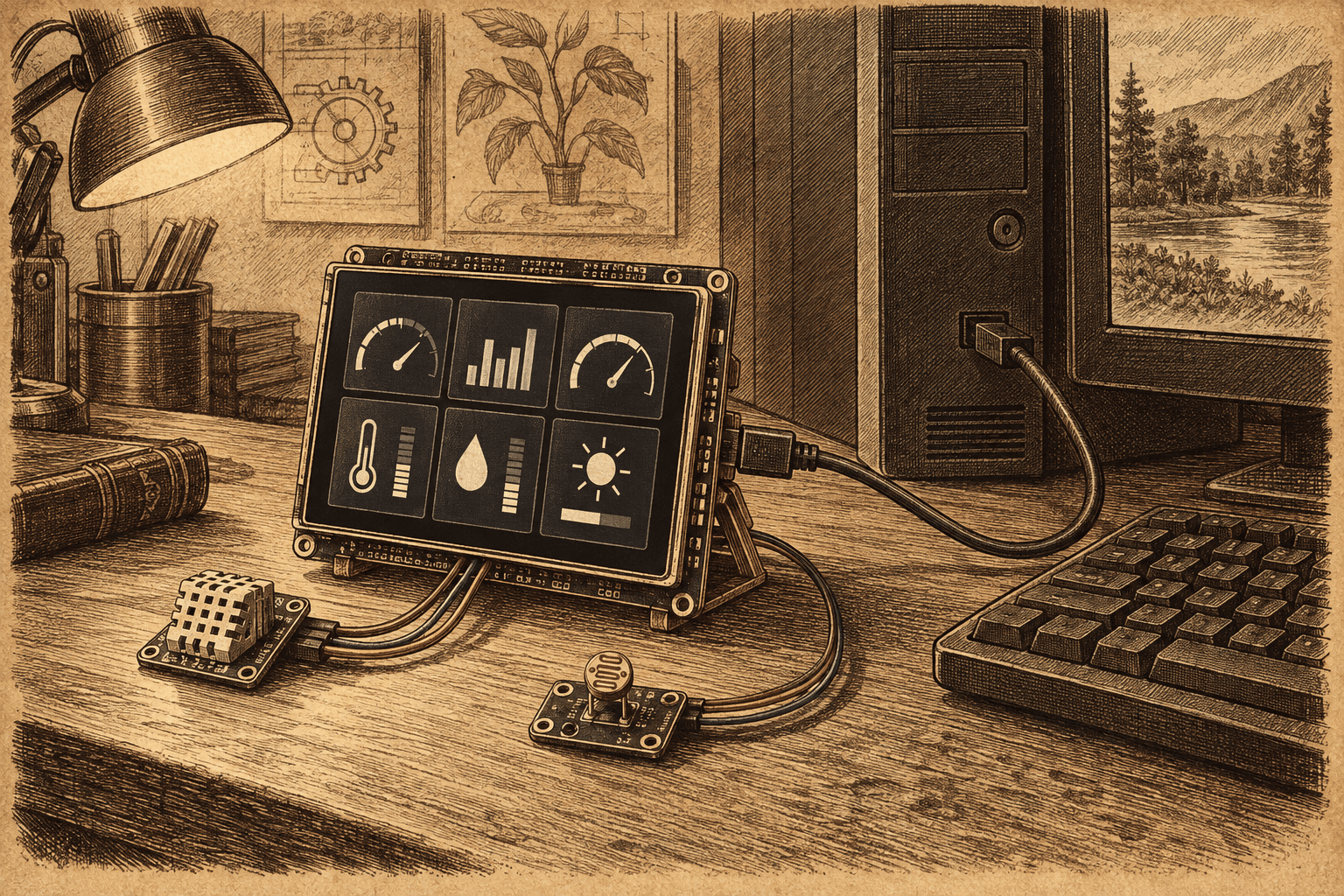
Turns a bare ESP32-S3 touchscreen into a USB-connected desk instrument for PC activity and optional room temperature, humidity, and light measurements.
Visit DeskNodeOriginal Codex Image Gen concept art from 2026-07-10; carried forward from the validated 2026-09-26 edition.
Desk Picks are selected by the newsroom. Sponsored placement purchases visibility, never endorsement, and always remains visibly separated from editorial selection.
 Editorial illustration